What is virtual try-on · 6 min read
What Is Virtual Try-On? Definition, Types and Examples for Fashion
A plain-English definition of virtual try-on for fashion teams: the main types, how AI try-on works from product images, what it is good for, where it stops, and what it takes to support it across a whole catalogue.
By Surajnarayanan SUpdated
Definition
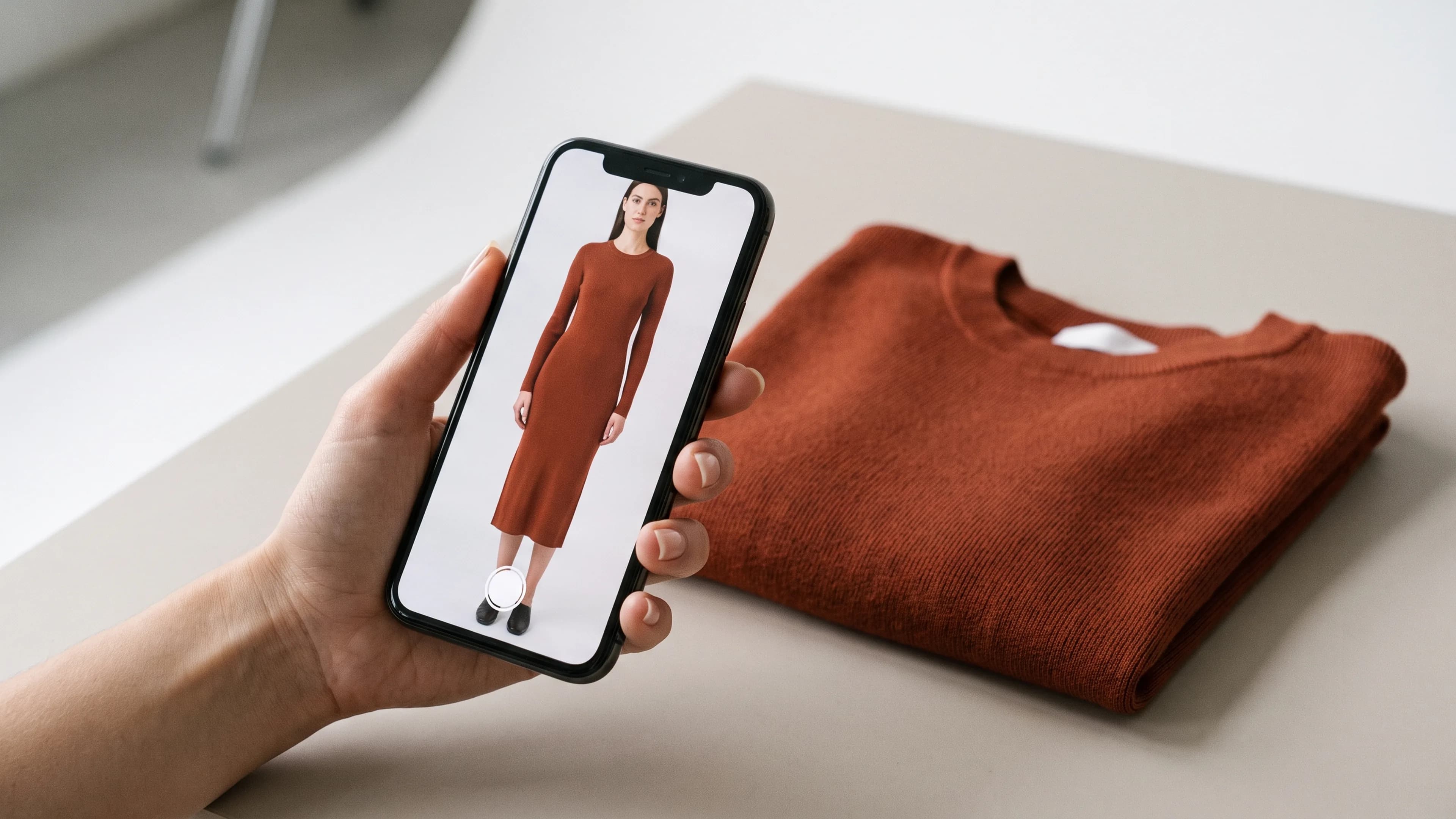
Virtual try-on (VTO) is technology that shows a shopper how a garment, accessory or beauty product might look on their own body, face or an avatar before they buy, using a photo, a live camera view or a 3D model. In fashion it is a shopping preview, not a finished product photo, and it does not confirm size or fit on its own.
At a glance
- A preview of a product on the shopper or their avatar, made for that shopper, not an approved catalogue still
- Main forms: live camera AR, photo-based AI try-on and 3D avatar fitting, now also inside shopping assistants
- Most fashion try-on reads the product from its photos, so image accuracy decides what the shopper sees
8M Studio is a managed AI fashion production studio, not a virtual try-on app. This glossary entry defines the term and explains the product imagery try-on depends on.
Direct answer
Virtual try-on lets a shopper preview a product on themselves or an avatar. In fashion it usually takes one of three forms: live camera AR, a photo-based AI render, or a 3D avatar. All of them depend on accurate product images, and none of them replaces size charts and fit notes on the page.
Best for
- +Ecommerce, product and CX leads who keep hearing “VTO” and want a plain definition before a vendor call
- +Catalogue teams asked whether their current product images will hold up inside a try-on feature
- +Founders weighing a try-on tool against on-model catalogue production for the first time
Not designed for
- -A ranking or review of virtual try-on apps
- -Fit-accuracy, return-rate or conversion claims for any tool
- -Getting listed in ChatGPT shopping; that brief is the ChatGPT virtual try-on guide
- -Legal advice on shopper photos, biometric data or AI image labelling
Virtual try-on, defined
Virtual try-on is a preview, made for one shopper at one moment, of how a product might look when worn. The shopper gives a selfie, a full-length photo, a live camera view or body measurements, and the system combines that with the product's own images or 3D files to show a likely look.
It also goes by VTO, AI try-on or virtual fitting room. Eyewear and make-up took to camera try-on early, because a face is easier to track than a body. Apparel is harder: fabric drapes, stretches and layers.
What makes something a try-on is the person in the frame: the shopper or their stand-in, not a model the brand booked or generated. That separates try-on from on-model catalogue imagery; the virtual try-on vs on-model catalogue guide compares the two as buying decisions.
Types of virtual try-on, with examples
Fashion try-on comes in a few broad forms. Live camera AR places a product on a moving video feed. Photo-based AI try-on renders a garment onto a still photo of the shopper. 3D avatar try-on drapes a digital garment on a body built from measurements. Each form asks the brand for different inputs.
| Form | What the shopper does | What the brand supplies | Example |
|---|---|---|---|
| Live camera AR | Points a phone or smart mirror at themselves | Product assets that track a face, wrist or foot | Sunglasses or trainers following the shopper on a live selfie view |
| Photo-based AI try-on | Uploads a photo of themselves | An accurate product image for each colourway | A wrap dress rendered onto the shopper's own full-length photo |
| 3D avatar try-on | Enters measurements or completes a body scan | 3D garment files from pattern and fabric data | A tailored jacket on an avatar sized to the shopper |
| Try-on inside a shopping assistant | Taps a try-on button on a listing | The product data and images already published | ChatGPT's Try on button on clothing listings |
Only 3D avatars work from construction data. The others infer the garment from photographs, which is why the ChatGPT virtual try-on guide starts with an accurate image per colourway.
How AI virtual try-on works
Photo-based AI try-on reads two images: one of the shopper and one of the product. A model maps the shopper's body and pose, separates the garment from its product photo, then generates a new image of the shopper wearing it, filling in drape, folds, shadow and any skin the garment covers or reveals.
- Read the shopper: body outline, pose and the clothing being replaced.
- Read the product: shape, colour, print, neckline, closures and length.
- Render: warp the garment to the pose, then paint plausible folds and light.
- Return a preview for that shopper, not a reviewed product asset.
The weak point is reading the product. If the photo hides a print, crops the hem or shows the wrong colourway, the render invents what it cannot see, the same failure covered in why DIY AI fashion images fail on garment fidelity.
What virtual try-on is good for, and where it stops
Try-on is good at helping a shopper picture colour, print and proportion on themselves, which makes browsing feel more personal. It is weak at telling them which size to order, because a photo-based render does not know the fabric's stretch or the pattern's measurements. Treat it as a visual aid that sits beside fit information.
- Good for: a colour against the shopper's own skin tone, a silhouette at a glance, styling ideas, shareable previews.
- Weak at: size advice, exact length on a particular body, how a fabric moves or feels.
- Not a substitute for: a size chart, fit notes, and clear on-model or packshot images.
- Not a catalogue asset: a one-shopper preview is never approved for a product page.
What a brand needs before offering virtual try-on
Before try-on can look right, the product side has to be ready. Each colourway needs its own accurate main image, garment details need to be visible, and the product page has to answer fit in words. Without that groundwork, shoppers get confident-looking previews of a product that is not quite the one that ships.
- One clean main image per colourway, showing the exact variant that ships.
- Visible detail: print scale, neckline, closures, hem length and true colour.
- Consistent framing, so a render is not guessing at a cropped or folded garment.
- Fit facts on the page: a size chart, fit notes and the size the model wears.
- A named owner who checks that what renders matches what ships.
Virtual try-on at scale with AI
At catalogue scale, the bottleneck is rarely the try-on engine. It is the product imagery behind it: a large range where many colourways were never photographed well. AI production can close that gap by turning flat-lays, mannequin shots or supplier packshots into consistent, reviewed images that a try-on feature, and the product page, can both rely on.
Take a knitwear range shot only as flat-lays, one colour per style. Try-on can render the knit it has, but the other colourways have nothing accurate to read. A reviewed on-model frame and packshot per colourway gives try-on and the product page the same source of truth.
Start from existing inputs: mannequin and flat-lay to on-model at scale and supplier packshots to on-model PDP images cover the conversion, and AI colorway swaps cover missing colours. With AI-generated fashion models, one face must hold across the range (identity lock); replacing a consented model's head across existing shots is an AI head swap job.
Check every frame before it ships, using the AI fashion imagery QC checklist, and run the volume through AI Catalogue Production when you want one accountable owner for the approved images.
Frequently asked questions
What is virtual try-on in simple terms?
It is a preview of how a product might look on you before you buy it. You use your phone camera, a photo of yourself or an avatar, and the app shows the product worn. It is a visual guide, not a promise of fit.
What is the difference between virtual try-on and AI virtual try-on?
Virtual try-on is the umbrella term. AI virtual try-on usually means the photo-based kind, where a generative model renders a garment onto a still photo of the shopper. Live camera AR and 3D avatar try-on rely more on tracking or on 3D garment files.
Does virtual try-on show the right size?
Not reliably. Photo-based try-on reads the garment from images and does not know fabric stretch or pattern measurements, so it shows a likely look rather than a fit. Keep size charts, fit notes and the size the model wears on the product page.
What product images does a brand need for virtual try-on?
At minimum, one clean and accurate main image per colourway, showing the exact variant that ships, with print, neckline, closures, length and colour clearly visible. 3D avatar try-on also needs 3D garment files built from pattern and fabric data.
Is virtual try-on the same as on-model product photography?
No. Try-on shows the product on the shopper or their avatar, for that session only. On-model product photography is a finished, reviewed image of a model wearing the product, used on product pages and in ads. Many brands need both.
Can AI produce product images for virtual try-on at scale?
Yes, as long as every image is checked for garment accuracy before it ships. AI production can turn flat-lays, mannequin shots and supplier packshots into consistent on-model and packshot frames for each colourway, which gives a try-on feature cleaner inputs.
Does 8M Studio build virtual try-on apps?
No. 8M Studio is a managed AI fashion production studio. It produces approved on-model and catalogue images that a try-on feature or product page can use. It does not sell a try-on app or widget.
Evidence and sources
- OpenAI Help Center — Shopping with ChatGPT Search - Source for ChatGPT's Try on button and its note that try-on images do not guarantee fit or size. Already cited in the ChatGPT virtual try-on guide, checked 2026-10-06.
- Virtual try-on vs on-model catalogue imagery - Route guide that separates a shopper fit experience from finished catalogue assets. This entry defines the term and does not repeat that comparison.
- ChatGPT virtual try-on product images - Product-image brief for ChatGPT's try-on. This entry links to it rather than retelling it.
Continue the decision
Get the catalogue ready for try-on
8M Studio is a managed AI fashion production studio, not a try-on app. If try-on plans keep stalling on missing colourways, uneven framing or unreviewed product images, we produce approved on-model and packshot frames for the catalogue behind it. Book a production-fit call to scope the range.