Model release AI consent fashion · 9 min read
Does Your Model Release Cover AI? Model Consent for Fashion Brands Reusing Shoot Photos
Can you use AI on existing real-model shoot photos to show new garments, poses, colourways or settings? Where the line between an edit and a new depiction sits, what Pujols v. Rainbow and New York's Fashion Workers Act add, and what a release should say.
By Surajnarayanan SUpdated
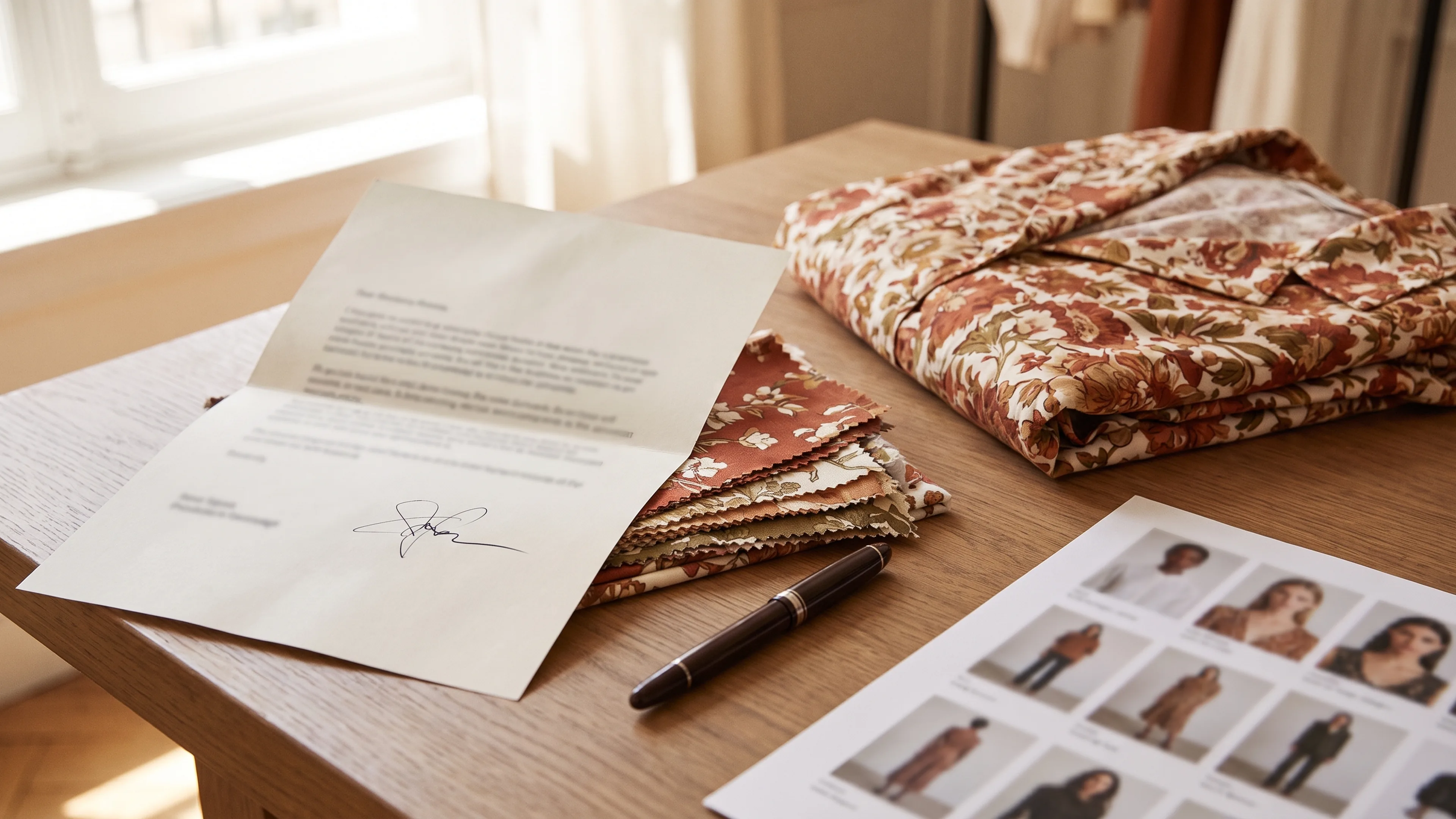
This is not legal advice. This guide summarises public reporting and law-firm commentary as read on 13 October 2026. Pujols v. Rainbow is a pending case with no ruling on the merits. Have your own counsel review releases, contracts and any specific image.
At a glance
- Routine edits such as retouching are one thing; AI-made new poses, garments, hair or settings of a real model are another
- New York's Fashion Workers Act requires clear, conspicuous prior written consent for a model's digital replica, covering scope, purpose, pay and duration
- A per-workflow table, release clauses and vendor questions, plus where AI-generated models change the question
8M Studio is a managed AI fashion production studio, not a law firm. This page is for brand, ecommerce and creative-ops teams preparing questions for counsel and vendors.
Direct answer
Usually not for new depictions. A standard model release generally covers routine edits such as retouching. Using AI to put the same recognisable model in new poses, garments, hair or settings is closer to a new shoot. New York's Fashion Workers Act requires prior written consent for a digital replica, and a pending New York case tests whether broad “altered” release wording is enough.
Best for
- +Fashion brands with real-model shoot libraries who want AI to add garments, colourways, poses or settings
- +Ecommerce and creative-ops leads writing or renewing model releases and agency booking terms
- +Teams briefing an AI image vendor and deciding what consent paperwork the job needs first
Not designed for
- -Legal advice or a release template to sign without counsel
- -Swapping one model's face or identity for another, a separate question with separate consent issues
- -Ad-disclosure and labelling rules for AI-generated people, covered in the Amazon and EU AI Act guides
- -Children or minors in any imagery; celebrity likeness
Edit or new depiction: the line that decides consent
The working question is whether AI edits a photo the model agreed to, or makes a new picture of the model they never posed for. Retouching and crops are edits. A new pose, garment, hairstyle or setting is closer to a new shoot, and is where releases written before generative AI run thin.
ArentFox Schiff, writing about the Pujols case, offers a practical test. Paraphrased: if the model would have had to come back to the studio, you need AI consent. It is a rule of thumb from a law firm's commentary, not a statute or a ruling, but it maps neatly onto catalogue workflows.
New York's Fashion Workers Act points the same way. As ArentFox Schiff summarises it, routine retouching is excluded from its digital replica consent rule; making a replica of the model is not.
What the Pujols v. Rainbow case is about
A model is suing the retailer Rainbow in New York Supreme Court (Index No. 157543/2026), alleging it used AI to turn photos from a licensed shoot into new depictions of her. The case is pending. A preliminary injunction was denied on 16 July 2026, and no court has ruled on whether her release covered the AI images.
The allegations
As reported, the complaint says Rainbow used AI to create new depictions from the licensed shoot photos, changing her poses, hair, clothing, settings and body positioning. Loeb & Loeb frames the question the case raises as when an AI alteration becomes a new depiction.
Timeline as reported
- 15 June 2026: filed in New York Supreme Court as Pujols v. Rainbow (Index No. 157543/2026).
- 16 July 2026: the motion for a preliminary injunction is denied. This is a procedural stage, not a decision on the merits.
- Rainbow has moved to dismiss, arguing its release already covers the images.
The release wording at the centre of it
Rainbow relies on broad release language allowing the images to be altered, composited or transformed. Many standard releases contain similar wording. The open question is whether words written for retouching and compositing stretch to AI-generated new depictions. Until a court answers it, treat broad “altered” wording as contested, not settled.
What New York's Fashion Workers Act requires
Per ArentFox Schiff's summary, New York's Fashion Workers Act took effect on 19 June 2025. Creating or using a model's digital replica needs clear, conspicuous prior written consent that describes the scope, purpose, pay and duration. Routine retouching is excluded.
For brands, the practical point is timing: if AI new depictions are planned for a New York booking, write the consent for them up front. How the Act applies to a particular booking, or to a release signed before June 2025, is a question for counsel.
Per-workflow consent table for catalogue teams
Map each AI job to how far it moves from the photo the model actually posed for. Routine edits sit at one end. New garments, poses and settings sit at the other, where a cautious team gets express AI consent first. The table below is a starting point to agree with counsel, not a determination.
| AI job on a real-model photo | What changes | Cautious consent read |
|---|---|---|
| Colour correction, dust and blemish cleanup, minor retouching | Nothing about what the model did | Likely covered by a standard release; routine retouching is excluded from the FWA digital replica rule |
| Crop, reframe or aspect-ratio fill for a channel | Framing only | Likely covered, unless the crop changes the meaning or pairing |
| Background removed or cleaned to a studio white | Background only, no new scene | Likely covered as standard post-production |
| AI colourway swap of the same garment the model wore | Garment colour shown | Grey zone. The model wore a different colour; get consent wording that names colourway variants |
| A different garment or product placed on the model | Clothing worn | Likely a new depiction. Get express AI consent naming the use |
| New pose or body positioning | What the model physically did | Likely a new depiction. Get express AI consent |
| New hair, body shape, skin or age appearance | The model's appearance | Likely a new depiction, and sensitive. Get express AI consent and model approval |
| New setting or lifestyle scene behind the same pose | Context and implied endorsement | Grey to likely new depiction, especially if it pairs the model with a new product or message |
| A reusable AI likeness (digital twin) trained on the shoot photos | Everything, on demand | Digital replica territory. Separate written consent with scope, purpose, pay and duration |
Colourway work has its own production checks in AI colorway swaps for an on-model catalogue. Holding one person across a set is fashion AI identity lock. Whatever the consent position, a frame that misrepresents the garment still fails QC; that gate is in the AI fashion imagery QC checklist.
What to put in the model release before the next shoot
Write AI uses into the release and booking terms as their own section, not inside a general “altered or transformed” clause. Name the AI uses allowed, the purpose and channels, the pay, the duration, any approval right, and what happens to source files and any likeness afterward. Then have counsel adapt it per market.
- Scope: list allowed AI uses separately from routine retouching, for example colourway variants, other SKUs from the same range, new backgrounds, new poses. Name what is excluded.
- Purpose and channels: PDP, marketplace, paid social, print, out of home. Say whether new-product pairings or new campaigns are included.
- Pay: a separate fee or rate for AI-made images, so the Fashion Workers Act's pay element is met where it applies.
- Duration and territory: how long AI images may run, where, and whether new ones can be made after the term ends.
- Approval: whether the model or agency approves AI images before publication, and the turnaround.
- Likeness and training: whether shoot photos may train or fine-tune any model, and whether a reusable likeness may be kept. Many models will refuse this; ask separately.
- Storage and deletion: what happens to source files, trained weights and replicas at the end of the term.
- Agency alignment: make sure the agency's booking terms and the brand's release say the same thing.
- Existing libraries: for photos shot under older releases, consider a short written addendum before running AI new depictions, rather than relying on broad “altered” wording.
Questions to put to your AI image vendor
Your vendor's process decides whether the consent you hold is respected in practice. Ask in writing what the vendor does with your shoot photos, whether they train on them, which edits they make per image, and what happens to frames that go beyond the consent you hold. Put the answers into the statement of work.
- Will our real-model shoot photos be used to train, fine-tune or build a reusable likeness? If so, under what consent, and is it deleted at the end?
- Will the model's likeness ever be used outside our job, or for other clients?
- For each delivered image, can you record whether it was a routine edit or a new depiction (new garment, pose, body, setting)?
- Will you hold, rather than deliver, frames that go beyond the consent scope we give you?
- Do you work from our consent summary per model, and who on your side checks it?
- If a model withdraws consent or a term expires, how fast can you identify and remove affected images and files?
- Which AI images need disclosure or metadata by channel (Amazon, Google Shopping, EU storefronts), and who applies it?
Where AI-generated models change the question
A photoreal model generated by AI from mannequin, flat-lay or packshot inputs is not a real person's likeness, so there is no release to stretch. The generated person must not resemble a real individual, and consumer-side disclosure rules for AI-generated people apply instead; those are covered in Amazon's AI-generated model image tag.
That route starts from product, not from a model's past shoot. It is described in mannequin and flat-lay to on-model at scale and supplier packshots to on-model PDP images. EU labelling is in EU AI Act and AI fashion product images. If the brief really needs a specific real model, a reshoot or a properly consented AI job may be the right answer; see when not to use AI fashion images. Self-serve and managed options for generated models, and brand-owned characters, are compared in AI fashion models.
Where 8M Studio fits
8M Studio is a managed AI fashion production studio, not a law firm and not a self-serve generator. It can run catalogue and campaign work from product inputs with AI-generated models, or work within a consent scope the brand provides for real-model photos, with a per-image record of what was changed.
The brand still owns the release, the consent decision and the legal read with its counsel. There is no rate card on this page.
- AI Catalogue Production: recurring on-model PDP volume, typically from mannequin, flat-lay or supplier inputs.
- AI Campaign Production: art-directed image families. Decide early whether talent is real and consented or synthetic.
- Custom AI Production Systems: when consent scopes, image records and hold rules must live inside your own pipeline.
Checklist before you reuse shoot photos with AI
Before any AI job touches a real model's photos, know which release covers them, what it says about AI, and which planned edits count as new depictions. Get a written addendum where the release is silent or broad, record the consent scope per model, and give the vendor a hold rule for anything outside it.
- List the shoot libraries in scope, with the release and booking terms behind each model.
- Classify each planned AI job with the per-workflow table: routine edit, grey zone or new depiction.
- For grey-zone and new-depiction jobs, check for express AI wording. Broad “altered or transformed” wording is contested.
- Where models worked in New York from 19 June 2025, check the Fashion Workers Act elements: prior written consent, scope, purpose, pay, duration.
- Get written addenda before the work, not after publication.
- Give the vendor a per-model consent summary and a hold rule, and get a per-image edit record back.
- Plan disclosure separately for any fully AI-generated people.
- Re-check this page and your counsel's advice after the next ruling in Pujols v. Rainbow.
Not legal advice. Confirm consent decisions with your counsel.
Frequently asked questions
Does a standard model release cover AI edits?
It usually covers routine edits such as retouching. Whether broad “altered or transformed” wording covers AI-made new poses, garments or settings is being tested in Pujols v. Rainbow, with no ruling on the merits yet. A cautious brand gets express AI wording.
What is the Pujols v. Rainbow case?
A pending New York Supreme Court case (Index No. 157543/2026), filed on 15 June 2026, in which a model alleges the retailer used AI to create new depictions of her from licensed shoot photos. A preliminary injunction was denied on 16 July 2026. Rainbow has moved to dismiss, citing its broad release language.
What does New York's Fashion Workers Act say about AI?
Since 19 June 2025, creating or using a model's digital replica needs clear, conspicuous prior written consent describing scope, purpose, pay and duration. Routine retouching is excluded.
Is changing the garment colour on a model photo a new depiction?
It is a grey zone. The model wore a different colour, so the image shows something that did not happen, but it is close to a routine edit. Consent wording that names colourway variants removes the doubt.
Do we need new consent to put a different product on an existing model photo?
Likely yes. A different garment, pose, hairstyle or setting is closer to a new shoot than an edit. ArentFox Schiff's rule of thumb: if the model would have had to come back to the studio, you need AI consent.
Do AI-generated models avoid the release problem?
They avoid stretching a real model's release, because no real person's likeness is used, as long as the generated person doesn't resemble a real individual. They bring consumer-side disclosure duties instead, such as Amazon's tag and EU AI Act labelling where they apply.
Can 8M Studio tell us whether our release covers AI?
No. That is a legal call for your counsel. 8M Studio is a managed production studio. It can work within the consent scope you provide, keep a per-image record of what was changed, or produce on-model images with AI-generated models from product inputs.
Evidence and sources
- The Fashion Law — Pujols v. Rainbow Shops, Inc. case documentation - Case filing (Index No. 157543/2026) and docket timeline, including the preliminary injunction denial on 16 July 2026. Read 2026-10-13.
- ArentFox Schiff — Does your image license cover AI? Pujols v. Rainbow USA and the risks of AI-generated model replicas - September 2026. The Fashion Workers Act digital replica consent summary and the paraphrased “come back to the studio” rule of thumb. Read 2026-10-13.
- Loeb & Loeb — When does an AI alteration become a new depiction? - Commentary on the edit versus new-depiction line, July 2026. Read 2026-10-13.
Continue the decision
Sort consent before the next AI job
Not legal advice. Classify each planned AI job on your shoot library, get express consent where it becomes a new depiction, and give your vendor a hold rule. When you want on-model images from product inputs instead, book a production-fit call for AI Catalogue Production.