AI fashion models · 8 min read
AI Fashion Models: Self-Serve vs Managed, Licensing and Brand-Owned Characters
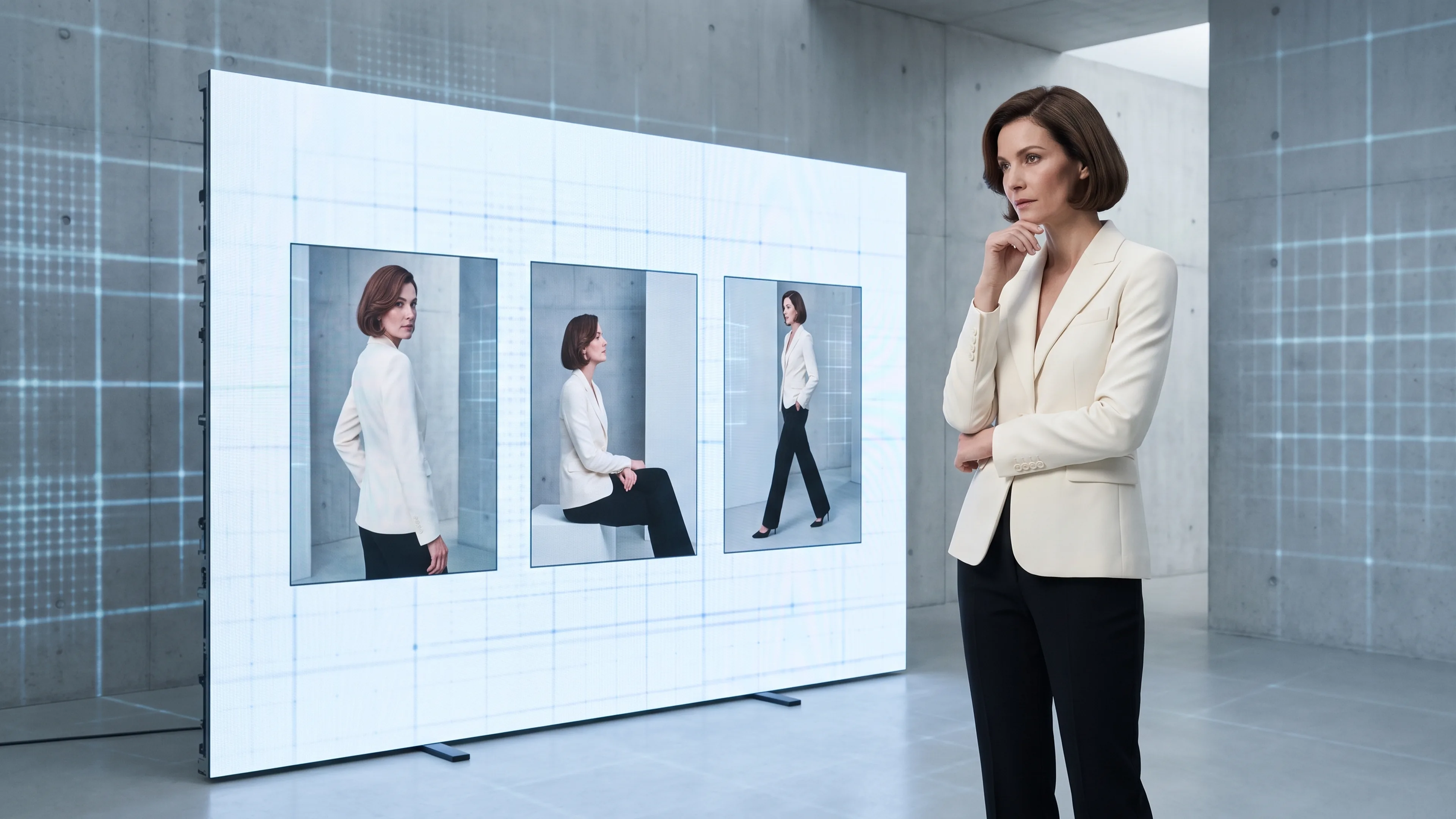
An AI fashion model is a photoreal person generated by AI, not photographed, who wears a brand's real garments in ecommerce, catalogue or campaign images. This guide compares self-serve generators with managed production, explains licensing and consent, and covers brand-owned characters that stay the same across a catalogue.
By Surajnarayanan SUpdated
Direct answer
Pick self-serve generators when one person can test looks and accept some drift. Pick managed production when the catalogue needs the same model across drops, garments that match the product, human review and clear usage terms. Either way, settle who owns the model's look, and never let an AI model copy a real person without consent.
Best for
- +Fashion and ecommerce teams deciding between a self-serve AI model generator and a managed studio
- +Brands considering a recurring AI model or a brand-owned character for catalogue and campaign work
- +Creative-ops and legal leads drafting usage, exclusivity and consent terms for AI-generated people
Not designed for
- -A ranking or review of named AI model tools
- -Legal advice; take licensing and consent decisions to your counsel
- -Children or minors in any imagery, or celebrity likeness
- -Consumer virtual try-on apps
What counts as an AI fashion model
In practice the term covers a generated person wearing your real garment, made from product inputs such as flat-lays, mannequin shots or supplier packshots. It is not a photo of a real model edited afterwards, and it is not a shopper trying clothes on through an app. Those are different jobs with different rules.
- Generated model from product inputs: a new, synthetic person on your garment. The production route is in mannequin and flat-lay to on-model at scale.
- AI edits of a real model's shoot photos: the person is real, so their release and consent decide what you can change.
- AI head swap: an existing catalogue photo keeps its garment, pose and framing while the head and identity are replaced.
- Virtual try-on: a shopper-facing preview, not a finished catalogue asset. The difference is in virtual try-on vs on-model catalogue imagery.
Self-serve generators vs managed production
Self-serve generators put the controls in your hands: you upload product images, choose or prompt a model, and pick the frames you like. Managed production hands the same job to a studio that owns the input checks, the model reference, human review and delivery. The real difference is who carries the rework.
| Question | Self-serve generator | Managed production |
|---|---|---|
| Who operates it | Your team, inside the tool | The studio, against your brief |
| Where the model comes from | The tool's preset models or your own prompts. Check whether presets are shared with other users | A reference agreed for your brand and reused across the programme |
| Garment accuracy | Your team spots print, colour, neckline and fit errors before publishing | Checked against the real garment in human review. Failed frames are reworked or held |
| The same face across drops | Depends on the tool and on your own discipline | Held by a locked reference pack and Accept, Rework or Hold review |
| Usage terms | Set by the tool's terms of service. Read them for commercial use and exclusivity | Written into your contract for the job |
| Good first use | Testing looks, small ranges, internal mood boards | Recurring catalogue volume, campaign families, brand-owned characters |
The wider operating-model comparison is in managed AI product photography vs self-serve generators and AI fashion tools vs managed production. The failure most teams meet first is a model that looks right on a garment that does not: see why DIY AI fashion images fail on garment fidelity.
Three situations and the option that fits
The right option follows the job, not the hype around the tool. Three common situations show how the choice usually falls. None of them needs a particular vendor, and each one has a point at which it should move to the other route, which is worth agreeing internally before anyone starts generating.
A new label testing on-model images
A small brand with a knitwear capsule and a founder who runs the site can test a self-serve generator on a few hero products. Review every frame against the sample in hand. Move to managed production when rework eats the time the tool was meant to save, or when the same face has to return next season.
A catalogue team with weekly drops
An ecommerce team shipping new styles every week needs the same model on every product page, colour-true garments and a predictable approval queue. That is a production programme, not a tool licence. Managed catalogue production fits, with a reference pack and a hold rule agreed before the first batch.
A campaign that needs one recognisable face
A seasonal campaign running across paid social, the homepage and lookbook pages needs one character who reads as the same person in every setting. Treat that character as a brand asset: brief it, approve it, write its usage into the contract, and keep it for next season.
Licensing and consent for AI fashion models
Two questions decide what you can safely publish: whether a real person's likeness is involved, and what the terms say about the generated person. If a real model is involved, their release and consent come first. If the person is fully generated, the tool's terms or your studio contract decide what you may do with them.
- Commercial use: which channels, markets and media the images may run in.
- Exclusivity: whether the same generated face can be offered to other brands.
- Term: how long images may stay live, and whether new images can be made later.
- Inputs: whether your product photos, or any real person's photos, train or fine-tune a model, and what happens to them afterwards.
- Resemblance: who checks that a generated face does not look like a real, identifiable person.
- Ownership: whether the character's reference pack and look belong to you, the studio or the tool.
When a real model is involved
Training a look on a real model's photos, putting their face on new garments or building a reusable digital twin all start from a real person. Get express written AI consent that names the uses, pay and term. The detail, with a per-workflow table, is in does your model release cover AI?
When the model is fully generated
No release is needed for a person who does not exist, but two checks remain. The generated face must not resemble a real individual, including a celebrity or a model you have booked before. And the usage rights must be clear: commercial use, channels, term, and whether anyone else can use the same face.
Disclosure is a separate duty
Rights and disclosure are different questions. Some channels and markets set their own rules for images of AI-generated people. Amazon's tag is covered in Amazon AI-generated model images in fashion, and EU labelling in EU AI Act and AI fashion product images.
Brand-owned AI characters
A brand-owned character is a generated model commissioned for one brand, approved like a casting choice and reused across catalogue and campaign work. The point is continuity on your terms: the same face every season, ownership and usage agreed in contract, and no renewal call when a booked model's availability or fees change.
The commercial case is set out in brand-owned AI characters versus recurring model day-rates. Keeping the character recognisable across drops is an operating discipline, described in how to keep the same AI model across every product image.
- An approved reference set and a written casting sheet: age range, skin, hair, build and mood.
- Rules for when the character is used, swapped or left out, for example by category or market.
- A contract clause on ownership, exclusivity and what happens to the reference if you change studio.
- A review step that checks face and garment separately, so a consistent face never hides a wrong print or neckline.
- A view on range: one character, or a small cast that reflects your customers.
Where AI head swap fits
AI head swap starts from a real catalogue photo rather than a generated person. The garment, pose and framing stay from the source image, and the head and identity are replaced so one face holds across SKUs. It suits brands with existing photography who want consistency, and it brings its own consent questions about whose photos are used.
How the route works is on the AI head swap for fashion catalogues page, and a published example is the fashion brand AI head swap case study.
Questions to ask any AI fashion model provider
Whichever route you choose, ask the same questions in writing before the first paid batch. The answers tell you who owns the model's look, who fixes a wrong garment, and what happens to your product photos. Vague answers on any of them are a reason to slow down, not to sign.
- Is the model we use exclusive to us, or available to other customers?
- Can we keep the reference and use the character with another studio later?
- Are our product photos used to train anything beyond our own job?
- Who reviews each image against the real garment, and what happens to frames that fail?
- How do you check that a generated face does not resemble a real person?
- Which images need AI disclosure or metadata on our channels, and who adds it?
Frame-level checks are in the AI fashion imagery QC checklist. If the honest answer is that the brief needs a real shoot, read when not to use AI fashion images.
Where 8M Studio fits
8M Studio is a managed AI fashion production studio, not a self-serve generator and not a model agency. It produces on-model catalogue and campaign images from your product inputs, with a model reference agreed for your brand, human review against the real garment, and usage terms set in the contract for each job.
- AI Catalogue Production: recurring on-model product page images with one model held across drops.
- AI Campaign Production: art-directed image families built around a character you approve.
- Custom AI Production Systems: when model references, consent records and review rules need to live inside your own pipeline.
Not legal advice. Confirm licensing and consent decisions with your counsel.
Frequently asked questions
What is an AI fashion model?
A photoreal person generated by AI, not photographed, shown wearing a brand's real garments in ecommerce, catalogue or campaign images. It is usually made from product inputs such as flat-lays, mannequin shots or supplier packshots.
Is a free AI fashion model generator enough for a catalogue?
It can be enough to test a look on a few products. A catalogue also needs garment accuracy, the same model across drops, review of every frame and clear commercial terms. Check what a free plan's terms allow before you publish anything.
Who owns an AI-generated fashion model?
It depends on the tool's terms or your contract, and on local law, so do not assume. Put ownership of the character, exclusivity and what happens to the reference in writing, and have counsel review it.
Can an AI fashion model look like a real person?
It should not, unless that person has given express written consent. A generated face that resembles a real model, a celebrity or a member of the public creates likeness risk. Build a resemblance check into review.
What is an AI model agency?
The phrase is used for providers that offer AI-generated models for brands to license instead of booking human talent. Ask what you would ask any agency: exclusivity, usage, term, and who is responsible when an image goes wrong.
Do images with AI fashion models need to be labelled?
Sometimes, depending on the channel and market. Amazon has its own tag for AI-generated people, Google Merchant Center requires AI-origin metadata on generative AI images, and the EU AI Act adds transparency duties where they apply. Check each channel you sell on.
How is AI head swap different from an AI fashion model?
AI head swap edits an existing catalogue photo: the garment, pose and framing stay, and the head and identity change. An AI fashion model is generated from product inputs. Head swap needs consent for the source photos; a generated model needs clear usage terms.
Does 8M Studio sell an AI fashion model generator?
No. 8M Studio is a managed production studio that delivers reviewed on-model images with a model reference agreed for your brand. To check whether your range fits, book a production-fit call.
Evidence and sources
- Google Merchant Center Help says images created with generative AI must include IPTC DigitalSourceType metadata indicating AI origin, and that this metadata must not be removed. Verified 2026-09-26.
Continue the decision
Choose the route before you choose the face
Decide whether you need a tool or a production programme, settle usage and consent in writing, then pick the model. When the answer is managed catalogue or campaign work, book a production-fit call.