AI campaign production vs catalogue production · 12 min read
AI Campaign vs Catalogue Production: Different Briefs, Families, and Approvals
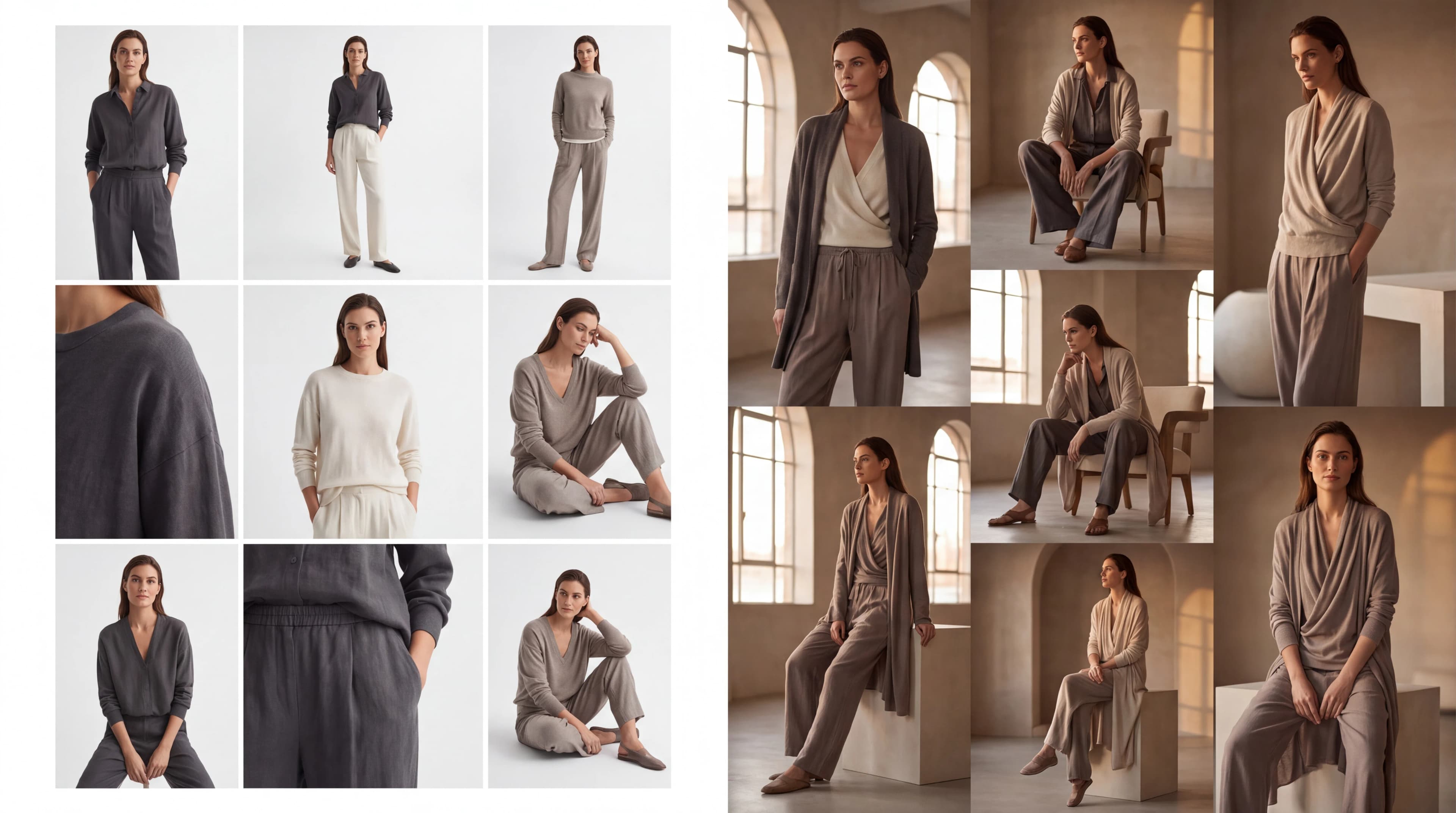
A route chooser for AI fashion ecommerce: catalogue production is approved product-truth volume, and campaign production is an art-directed image family, with different briefs and approval owners.
By Surajnarayanan SUpdated
At a glance
- Catalogue = approved product-truth volume across SKUs
- Campaign = art-directed image families for launches / lifestyle
- Same fidelity + identity hygiene; different briefs, art direction, and approval owners
8M Studio is a managed production studio, not a self-serve AI tool. This page is a route chooser between catalogue jobs and campaign jobs. It is useful even if you never work with us.
Direct answer
Campaign production and catalogue production are different jobs in AI fashion ecommerce. Catalogue programmes deliver approved product-truth frames across many SKUs—PDP, packshot, on-model books—under batch QC. Campaign programmes deliver art-directed image families with coherent mood, casting, and story for launches and lifestyle sets. Both need garment fidelity and identity rules; they differ in brief shape, art direction, and who approves the family. Choose AI Catalogue for volume product truth; AI Campaign when family coherence is the deliverable.
Best for
- +Brand, ecommerce and creative leads choosing between catalogue volume and campaign launch imagery
- +Teams that have catalogue AI working and now need coherent campaign families
- +Buyers who want a claims-safe route map before booking a production-fit call
Not designed for
- -Fake viral AI campaign tutorials or invented case-study revenue claims
- -Consumer lifestyle generators or free-credit funnels
- -Keyword-difficulty charts or blocked client name-drops
- -A universal rate card
What catalogue production means in AI fashion ecommerce
Catalogue production delivers approved product-truth frames across many SKUs. The usual destinations are the PDP, the packshot and the on-model book. The score that matters is first-pass approval and cost per approved SKU, not a single polished hero.
The cadence is a drop or a refresh calendar, with batch Accept, Rework and Hold. A frame that looks finished still fails if print, lace, colour or identity moves on the next SKU. Write those holds before volume.
This page does not restate the volume diagnosis. When approved catalogue delivery is what stalls the calendar, read the fashion catalogue production bottleneck guide. Shopify brands running that cadence as an on-model programme should read Shopify batch on-model AI product photos. The conversion method from mannequin or flat-lay inputs is on-model at scale. The failure pattern on hard garments is why DIY AI fashion images fail on garment fidelity. The working form is the AI fashion imagery QC checklist.
What campaign production means in AI fashion ecommerce
Campaign production delivers an art-directed image family. Mood, casting, lighting and story have to read as one set across a launch or a lifestyle series. A pretty single is not the deliverable. Family coherence is. The managed route for that family — brief, review and channel files — is AI Campaign Production.
The success metric is brand-fit approval of the family, not one hero in isolation. The cadence is a launch window, with creative direction and production QC in the same review. Product-truth still holds on hero garments. Art direction does not license a wrong print, lace, colour, neck or silhouette.
A campaign programme is not a published return figure, and this page does not attach a revenue result to a launch set. It names the job so the brief, the family rules and the approval owner are explicit before anyone generates a set.
Side-by-side: briefs, image families, art direction, consistency, approvals
Use the same words for both routes. The table describes typical operating models. It is not a scored ranking, and it does not assign invented stats to any tool or to either route.
| Dimension | Catalogue production (typical) | Campaign production (typical) |
|---|---|---|
| Primary job | Approved product-truth volume across SKUs | Coherent image family for a launch, lifestyle set or story |
| Brief shape | Shot list, views, colour refs and hard-SKU holds | Creative direction, family rules, and hero versus support roles |
| Image family | A consistent book across PDPs, with shared pose and crop language | Shared mood, lighting, casting and set language across the set |
| Art direction | Controlled studio and route consistency | Directional storytelling inside brand guardrails |
| Identity | Often one locked model across the book | Family coherence usually needs the same identity lock |
| Garment fidelity | Non-negotiable on every SKU | Non-negotiable on product heroes, and still in force on lifestyle frames |
| Approval owner | Catalogue or ecommerce QC | Creative, brand and production QC together |
| Failure mode | Fidelity drift, review bandwidth or identity drift | Pretty singles that do not read as one family |
| Typical 8M route | AI Catalogue | AI Campaign |
| When both must share one model | Custom AI Production Systems | The same pillar: one operating model for both routes |
Route map / Not a ranking
Two jobs, two briefs, two approval owners
Name the deliverable before you compare a catalogue sample with a lifestyle frame.
Catalogue
Approved product-truth volume across SKUs, under batch QC.
Campaign
An art-directed image family with coherent mood, casting and story.
Both
Custom AI Production Systems when one operating model must govern both.
ControlPrettier backgrounds do not turn a catalogue book into a campaign family.
Where teams mix the two routes (and why it fails)
The mix usually starts from a good sample. The sample answered one job. The calendar needed the other. These are the breaks that show up once a launch or a drop is already late.
Treating campaign as catalogue with prettier backgrounds
A catalogue shot list plus a new backdrop is still a catalogue brief. Campaign work needs family rules: which frames are heroes, which are support, and what mood, casting and set language must repeat. Without those rules, review argues about taste instead of coherence.
Shipping ungoverned lifestyle singles as a family
A folder of attractive frames is not a family. Family approval checks mood, lighting, casting and story across the set. If each frame could belong to a different brand, the set is not ready, however strong any one picture is.
Letting art direction override print, lace, colour or neck
Direction can change light, crop and set. It cannot change the garment the customer will receive. Print, lace, embroidery, trims, colour, neck and silhouette stay in scope on product heroes, and they still hold on lifestyle frames that sell the product. The failure pattern is why DIY AI fashion images fail on garment fidelity. The hold language is the AI fashion imagery QC checklist.
Skipping identity lock across campaign frames
A campaign family that recasts itself from frame to frame does not read as one talent. If the same person must span the catalogue book and the launch set, lock the reference before volume. The operating definition is fashion AI identity lock. This page does not repeat that reference-pack method.
DIY samples that look good once and fail family approval
Self-serve tools can fit contained tests when skilled operators own the review. Autophoto, Claid, Botika and WearView are category examples buyers already evaluate. They are not ranked here, and this page does not invent their prices, accuracy or a rate at which any of them fails a family. The operating-model choice is AI fashion tools versus managed production. Named criteria for Botika and Claid are in Botika and Claid versus managed fashion production. Named criteria for WearView and On-Model are in WearView and On-Model versus managed fashion production.
Decision guide: which route fits this brief?
Answer the job before you pick a pillar. The route follows the deliverable, not the sample that looked strongest in a deck.
- If the deliverable is primarily PDP or catalogue volume, the fit is AI Catalogue.
- If the deliverable is a launch, lifestyle or story family, the fit is AI Campaign.
- If catalogue, campaign and identity must share one governed pipeline, the fit is Custom AI Production Systems.
- If ghost or packshot is enough, and neither on-model nor lifestyle is required, the ghost mannequin chooser is still the right page.
- Price the approved deliverable, including review labour, not credits alone. The cost discipline is the fashion ecommerce pricing guide. This page does not publish a rate card.
Decision / Name the job
Choose the route from the deliverable
One question decides the pillar. The sample does not.
PDP volume
AI Catalogue when approved product-truth across SKUs is the job.
Launch family
AI Campaign when family coherence is the deliverable.
Both, one model
Custom AI Production Systems when the routes must be governed together.
ControlGhost and packshot remain valid when a worn or lifestyle view is not required.
What a managed AI Campaign programme includes
A campaign programme is a written operating model for the family, not a folder of lifestyle singles. These pieces have to exist before the set is treated as approved.
Creative and family brief
Name mood, casting, set language, and which frames are heroes versus support. A brief that only says “lifestyle” leaves coherence to whoever reviews last.
Identity lock before family volume
If one face must span the set, lock the reference pack before the family is generated at volume. The operating note is fashion AI identity lock.
Product-truth holds on hero garments
Accept, Rework and Hold stay separate states for print, lace, trims, colour, silhouette and neck. Pair them with the AI fashion imagery QC checklist and the garment fidelity guide.
Family review
Review the set together. Coherence across frames is the approval, not only whether one frame is beautiful. A hero that cannot sit beside its support frames is a rework of the family, not a win.
Channel readiness
Web crops, ad crops and file names belong in the brief. If Shopping uses the AI images, metadata is a separate check in Google Merchant Center AI product images. A compliant tag does not repair a wrong garment, and it does not make singles into a family.
How this page relates to live catalogue guides
The catalogue guides already live. This page does not replace them. It tells you which job you are in, then sends you to the page that owns that job.
The fashion catalogue production bottleneck guide is the volume and ops wall. Shopify batch on-model AI product photos is the commercial catalogue programme for Shopify PDPs. On-model at scale is the conversion route from mannequin or flat-lay inputs. Fashion AI identity lock is coherence across a book and across a campaign family.
Tool choice stays on its own pages. AI fashion tools versus managed production is the category operating model. Botika and Claid versus managed fashion production is the named criteria page. Fidelity, QC, Shopping metadata, ghost presentation and approved-unit cost stay on the garment fidelity guide, the QC checklist, Google Merchant Center AI product images, the ghost mannequin chooser and the pricing guide.
Where 8M Studio fits
8M Studio is a managed AI fashion catalogue and campaign production studio. It is not a self-serve AI tool. There is no credit dashboard and no free lifestyle generator on this page. Clients brief the job and the acceptance rules. The studio operates production and human QC within an agreed scope.
AI Campaign is the primary fit when the deliverable is an art-directed image family for a launch or a lifestyle set. AI Catalogue is the fit when the job is still approved product-truth volume. Custom AI Production Systems is the fit when catalogue, campaign and identity must share one operating model.
AI head swap is a capability inside Custom AI Production Systems for governed identity work. It is not the product on this page, and it is not a campaign generator.
Managed programmes can run at about 8k images a month in studio-partner-style pipelines. That figure describes operating scale. It is not a capacity promise for every brief, and it does not name partners.
If the next job is a launch family, define family coherence, lock identity where one talent must hold, and pilot the hard product heroes. How that family stays one look is AI campaign image families. Book a production-fit call when you need managed campaign delivery. When the prior question is whether this brief should use AI at all, the decision boundary is when not to use AI fashion images. When buyers mix a shopper try-on with finished on-model assets, the route distinction is virtual try-on vs on-model catalogue imagery. When the commercial question is a fashion shoot versus a managed AI programme, the cost-driver comparison is fashion shoot cost vs AI production.
Buyer checklist before choosing campaign vs catalogue
- Name the job: PDP volume, a launch family, or both.
- Name the approval owners: ecommerce QC, or creative and brand together with production QC.
- Lock identity rules if one face spans the catalogue, the campaign, or both. The operating note is fashion AI identity lock.
- Put hard garments — print, lace, embroidery and trims — in the paid pilot. Read why DIY AI fashion images fail on garment fidelity and the AI fashion imagery QC checklist.
- Define family coherence criteria before a campaign set is called approved.
- Price approved deliverables, including review labour, not credits alone. Use the fashion ecommerce pricing guide.
- Name channel rules: PDP specs, and Shopping metadata when ads use AI images. Use Google Merchant Center AI product images.
- Get data handling, retention and training-use answers in writing.
- Read the companions before you commit the route: the catalogue bottleneck, Shopify batch on-model, tools versus managed production, Botika and Claid, on-model at scale and the ghost mannequin chooser.
Before the brief / Control sheet
Choose campaign or catalogue only after these are named
The approved family and the approved SKU each have an owner before the calendar does.
The job
PDP volume, a launch family, or both under one operating model.
Owners and holds
Who signs the family, and who can Hold a wrong garment.
Identity and channel
The reference pack, PDP specs, and Shopping metadata when it applies.
Approved unit
The price includes review labour, not credits alone.
ControlIf a line cannot be answered, record the assumption before the launch or the drop.
Frequently asked questions
What is the difference between AI campaign production and catalogue production?
Catalogue production delivers approved product-truth frames across many SKUs for PDPs and books. Campaign production delivers art-directed image families with coherent mood, casting, and story for launches and lifestyle. Both need fidelity and QC; they differ in brief, art direction, and approval ownership.
When should a fashion brand choose AI Catalogue vs AI Campaign?
Choose AI Catalogue when the job is recurring product-truth volume. Choose AI Campaign when the deliverable is a coherent launch or lifestyle family. Choose Custom AI Production Systems when both routes plus identity must share one governed operating model. The job decides the pillar, not which sample looks prettier.
Can the same AI model identity appear in catalogue and campaign?
Yes, when identity is locked as a governed reference pack before volume. Random DIY faces create drift across PDPs and campaign frames. Plan identity once and apply it to both routes. Fashion AI identity lock is that operating definition: a reference pack, route rules, and Accept, Rework and Hold.
Does campaign production still require garment fidelity?
Yes. Art direction must not override print, lace, colour, neck, or silhouette truths on product heroes. Hold criteria stay in scope for campaign sets that sell the product. Pair those holds with the garment-fidelity guide and the QC checklist. A mood frame is still a product frame when it is meant to sell.
Why do DIY lifestyle samples fail as campaigns?
Pretty singles are not a family. Campaign approval needs coherent mood, casting, lighting, and story across the set, plus product-truth holds. Self-serve tools can fit contained tests when your team owns review. Managed programmes fit when family coherence and one delivery owner matter more than a credit price.
How is this different from the catalogue bottleneck guide?
The bottleneck guide explains volume and ops walls for catalogue delivery. This page is the route chooser between catalogue jobs and campaign jobs: briefs, families, art direction, and which offer pillar fits. Read the bottleneck guide when approved volume is the stall. Use this page when you still need to name the job.
What should I compare besides price per image?
Compare brief clarity, family coherence criteria, identity rules, garment fidelity holds, approval owners, agreed cadence, channel readiness, and cost per approved deliverable including review labour. A generation credit omits the review that decides whether a frame ships. Two quotes match only when the same hard garments are in scope.
What volume can a managed programme handle?
Programmes can run at about 8k images a month in studio-partner-style pipelines. That figure is operating context, not a guaranteed SLA for every brief, and it does not name partners. Do not treat it as a capacity promise. Price the route from approved units on a representative pilot.
Is 8M Studio a self-serve campaign generator?
No. 8M Studio is a managed AI fashion catalogue and campaign production studio. It is not a self-serve AI tool. This guide describes programme routes, not a credit dashboard or a free lifestyle generator. Clients brief the job and the acceptance rules. The studio operates production and human QC inside an agreed scope.
Where should I start if I already have catalogue AI working?
Define whether the next brief is still volume PDPs or a launch family. Lock identity if the same talent spans both. Pilot hard SKUs plus one small campaign family under Accept, Rework and Hold. Book a production-fit call when you need managed Campaign delivery rather than another catalogue batch.
Evidence and sources
- Fashion catalogue production bottleneck - Volume and ops diagnosis for catalogue delivery. This page is the route chooser, not a second bottleneck guide.
- Fashion AI identity lock - Operating definition for one recognisable model across a book or a campaign family.
- AI Campaign Production - Managed campaign route for art-directed image families. Primary offer pillar for this page.
Continue the decision
When the next job is a launch family
If your next job is a launch family, not just more PDPs, define family coherence, lock identity, and pilot the hard product heroes. Then book a production-fit call for managed AI Campaign delivery. AI Catalogue fits when the brief is still approved product-truth volume. Custom AI Production Systems fit when both routes must share one operating model.